What the Wingo Prediction page is designed to show
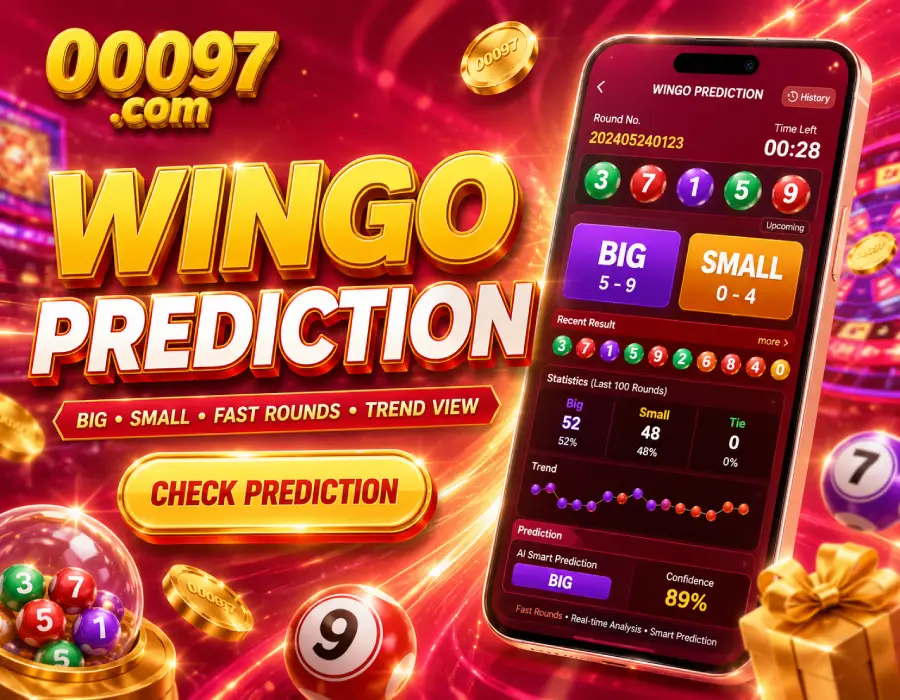
The Wingo Prediction page is designed as an information and estimate page, not as a guaranteed result page. Users who open this page usually want a fast card that shows period information, color estimate, Big Small estimate, number range and a confidence label.
The estimate card on 00097 includes a period number because period context matters. A color or number estimate without a period can be confusing. If users read an estimate after the period has already changed, they may misunderstand the display.
Color estimate, Big Small estimate and number range are separated into different boxes. Some users watch the color label. Some users watch Big or Small. Some users prefer a number range. Showing these values separately makes the page easier to read on PC and mobile.
The confidence label is not a promise. It is a visual note that tells users how the estimate is presented. Low, medium and high labels should never be treated as certainty.
Wingo color prediction and Big Small estimate explained
Many users search for Wingo color prediction because color labels are easy to read on mobile. The page displays color information as a clear value so users can quickly see whether the estimate card shows red, green or violet.
Big Small estimate is another common Wingo search topic. A Big Small display groups possible numbers into two broad categories. This can be easier for users who do not want to focus on every single number.
Number range gives a more detailed reference than a single Big Small label. Instead of showing only one number, the card can show a range such as 2 to 5 or 5 to 9.
The page should not use aggressive or unrealistic claims. Phrases such as guaranteed result, sure win, fixed next number or 100 percent accurate prediction create false expectations and should not be used.
Wingo period number, recent history and mobile reading order
The period number is the anchor of a Wingo estimate. Without the period, an estimate can become outdated very quickly. A user may open the page, leave it in the browser, return later and still see an old display.
Recent history is useful when it is shown clearly, but it should not be treated as a perfect pattern finder. History tables can help users review what has already appeared, but previous results do not control the next period.
The mobile reading order is simple. First, read the period. Second, read the color estimate. Third, check Big Small. Fourth, check the number range. Fifth, read confidence. Sixth, read the risk note.
The page also connects with other useful 00097 areas. Users who need account access can open the login guide. New visitors can read register information. Users who want game category information can open the 00097 Game page.
Responsible Wingo prediction use and common mistakes
Responsible use is the most important part of any prediction page. Users should not treat estimate values as instructions. They should not chase losses, increase risk after a result they did not expect or depend on a prediction card as a financial decision tool.
One common mistake is reading an old estimate. Another mistake is ignoring the period field. Another is believing that a recent history table proves a fixed pattern. Some users also focus only on high confidence and ignore the risk note.
The Wingo estimate card should be used as a display of reference information only. It can be part of entertainment reading, but it cannot remove uncertainty.
The final reminder is simple: read the tool carefully, check the full card, understand the risk note and use the page responsibly.
Frequently Asked Questions
Does Wingo Prediction guarantee the next result?
No. The estimate card is for information and entertainment reference only. It does not guarantee any future result.
What does the Wingo estimate card show?
It can show period number, color estimate, Big Small estimate, number range and confidence label.
Why should I check the period number?
The period tells which estimate display you are reading. Without checking it, you may read old or mismatched information.
Is recent history a fixed pattern?
No. Recent history gives context only and should not be treated as proof of the next result.
Continue Exploring 00097
Return to the 00097 homepage for 00097 Game access, 00097 Lottery information,
app download, login, register, prediction tools, gift code notes and invite code guidance.
Back to 00097 Home